

Featured Article:
Author: Vinodh Ramachandran, Neiman Marcus Group
In my previous article, I had spoken about some challenges due to a siloed working model within data & analytics teams in large retailers and how setting up a Data & Analytics CoE within the GCC can be a good solution.
Lets look at a few ways to structure the CoE within the GCC.
- Federated model (Data teams as verticals)
- Integrated model (Data teams as horizontals)
- Pod model/Pizza teams (Product based teams)
Federated model
In this model, the end-to-end capabilities within Data & Analytics is assembled aligning to the business teams. They will typically roll up to the GCC CoE leader who will have visibility to the project pipeline and will also have access to business leadership and the Chief Data & analytics officer (who they may report to). An illustration is show below:
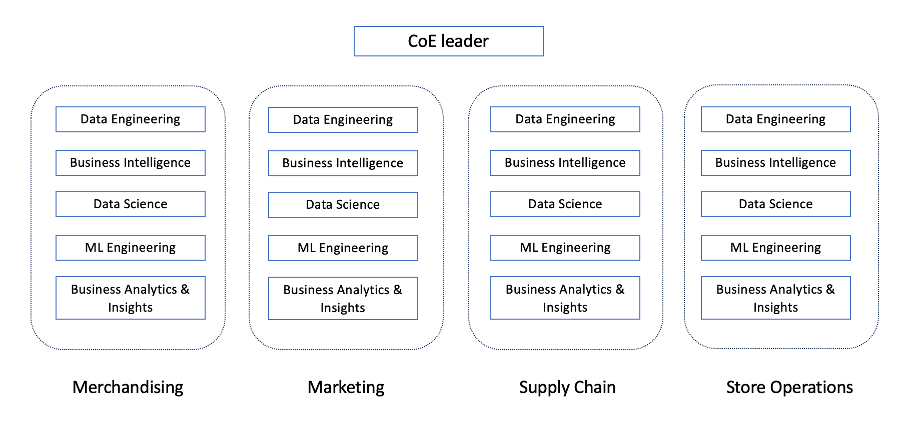
The federated model has a few advantages:
- Business Alignment and working on priorities that drive business impact
- Availability of dedicated bandwidth for businesses to move at their own pace
- A sense of ownership and belonging within the data & analytics teams
- Visibility to project pipeline and ability to bring teams together for cross functional initiatives driven by the CoE leader role
- Talent migration across teams
Integrated Model
In this model, the Business Analytics teams are set up to be aligned to the different business units. However, the data teams – Data engineering, BI, etc. are set up as horizontals and are not aligned to business teams. They are capabilities that are available to the CoE to leverage. This model also rolls up to the CoE leader who will have access to both the business leadership and the technology group (CDAO, CIO, etc.)
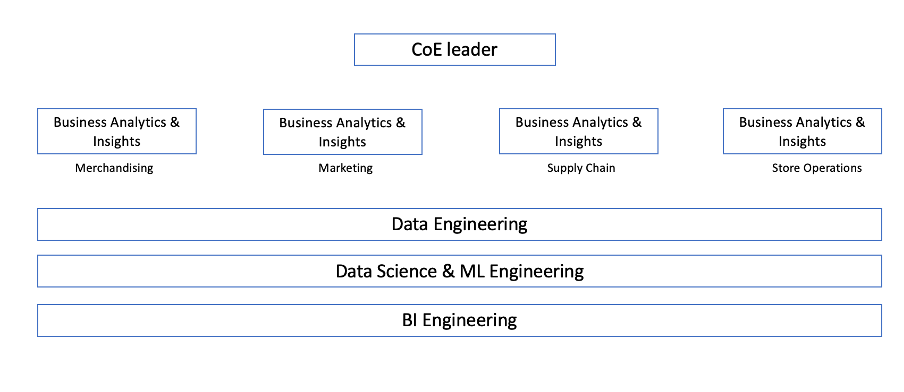
The integrated model offers fewer advantages than the federated model:
- Business Alignment and ability to work on prioritized projects based on impact to the business
- Visibility to project pipeline and ability to bring teams together for cross functional initiatives driven by the CoE leader role
- Opportunity to work on projects across multiple business teams. This increases the exposure and motivation of the data teams.
The integrated model however runs into the prioritization challenge with lack of dedicated bandwidth available for business analytics teams. Talent migration becomes a challenge and the CoE leader will have to create a career path that provides progressive increase in scope and impact to each individual.
Pod model/ Pizza teams
This is a popular model in e-commerce companies that are product based. For e.g. Search, Personalization, Last mile delivery, Customer returns, etc. In this model the teams are organized like the federated model, except they are aligned to product/ sub product teams.
A few advantages of this model over the federated model include:
- Razor sharp focus on business priorities (in this case product priorities)
- Drives depth in context and solutions
- Agile approach and hence focus is on speed to market. As an analyst, you will get to see the impact of your work very quickly
- Provides opportunities to closely collaborate with other teams within the product on a daily basis
These are some CoE models that I have seen through my experience. The role of the CoE leader, if defined right makes the biggest difference to the success of these models. Organizations must hence spend a lot of time to define this role right and hire the right individual to derive the maximum advantage.
My personal preference is the federated model as it checks a lot of boxes – business alignment, career pathing, motivated talent, and dedicated bandwidth. What is yours? Are there other models that you have come across? Please share your comments.
Disclaimer – All views expressed here are strictly personal and do not represent any company or team or individual
Title picture: freepik.com
India’s largest platform for AI & Analytics leaders, professionals & aspirants
3AI is India’s largest platform for AI & Analytics leaders, professionals & aspirants and a confluence of leading and marquee AI & Analytics leaders, experts, influencers & practitioners on one platform.
3AI platform enables leaders to engage with students and working professionals with 1:1 mentorship for competency augmentation and career enhancement opportunities through guided learning, contextualized interventions, focused knowledge sessions & conclaves, internship & placement assistance in AI & Analytics sphere.
3AI works closely with several academic institutions, enterprises, learning academies, startups, industry consortia to accelerate the growth of AI & Analytics industry and provide comprehensive suite of engage, learn & scale engagements and interventions to our members. 3AI platform have 16000+ active members from students & working professionals community, 500+ AI & Analytics thought leaders & mentors and an active outreach & engagement with 430+ enterprises & 125+ academic institutions.