

Personalization: The new age approach for augmenting Customer Experience
3AI October 8, 2020

As per recent report from Forrester Research, today’s hyper-connected consumer expect organizations to create far better personalized experiences and deliver value at all possible touch points of interaction. Consequently, the Marketers today understand that they need to step up their game and are ought to carry a strong appetite to expand personalization capabilities. Personalization has the potential to increase traffic, lead conversions, average order value, customer retention rate and lifetime customer value.
Not so surprisingly, most of the marketers claim that current technologies at their disposal today aren’t keeping pace with their personalization plans, and they keenly expect enterprise software vendors, big data analytics service providers and consumer app developers to help them reach their personalization goals over the next two to three years. Personalization using consumer’s emotional state, social media sentiment, and context still remains elusive to most. Majority of marketers believe that personalization directly impacts customer retention and brand loyalty, use personalization and targeting based on broad segmentation and simple clustering and currently use only customer-specified preference data to personalize customer experience on some or all channels. Email, call centers, and websites are still the key customer interaction channels & future marketing efforts shall heavily be focusing on mobile websites, applications, and social media channels. Challenges related to delivering content or offers to the consumer’s chosen channel in real time are still common place and marketers understand that Analytics has a critical role to play there.
The game is about to change & we’ll see a radical shift in the way marketing organizations shall operate. Soon enough we’ll observe increased spending on site optimization tools, real-time interaction management, deployment of predictive algorithms a common phenomenon to deliver hyper-personalized experiences to customers across all possible channels of engagement. Obviously, the role of large enterprise software vendors shall grow multi-folds to help marketers create a single repository of structured & unstructured customer data, centers of excellence or Analytics hubs shall be established to deliver critical insights to marketing organizations for effective marketing. For narrowing down on any personalization & recommendation solution, organizations must keep the following evaluation metrics in mind:
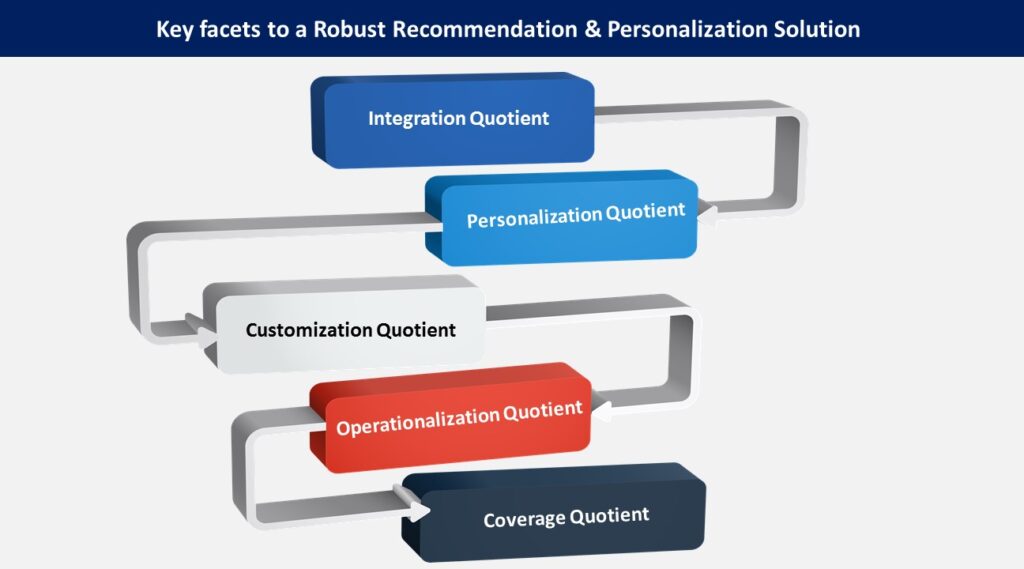
Integration Quotient
Ensure that solution being considered has the capacity to run and gel well with organization’s existing platform. Or even if the technology can’t run on their current platform, it must be a solution that can be integrated cost effectively. Integration should be easy and fast and, if needed, immediate to reap early benefits.
Personalization Quotient
Although all recommendation technology providers will claim to support some level of personalization, do doubly check that it’s truly a one-to-one personalization solution. One-to-one personalization delivers unique, relevant and dynamic recommendations with every click a customer makes as opposed to a solution that is based on the segmentation of categories or customer base. That’s the future of marketing & an area where marketers must be investing in to sustain in a hyper-competitive marketplace.
Customization Quotient
Recommendation tools typically use proprietary algorithms in combination with several data inputs, such as individual purchase history, shopping habits and product category. But the best solutions in this category are highly customizable and are flexible enough to work with existing business rules and marketing strategies. The ability to fine-tune makes a huge difference when trying to match the right product with the right customer at the right time.
Operationalization Quotient
It’s indispensable to be able to see exactly what your website visitors will see and have the ability to control your recommendations. Many vendors today offer a dashboard that enables previewing of how their product and content recommendation solution shall operate in a live environment before it is rolled out externally to the larger audience.
Coverage Quotient
Ideally, the business should be able to distribute these automated recommendations & insights across all possible interfaces with the customer: website, emails, mobile phones and tablets, social media sites, call centers, and in-store kiosks.
Goes unsaid, Analytics is the critical ingredient to any personalization solution or platform today. Some of the common Analytics techniques employed for personalization today are:
Rule-based Approaches
Rule-based approaches are way better than simple counting and saved value approaches. They are quite ubiquitous and powerful, are easy to deploy but have perennially been hard to scale. If you’re employing any testing tool or a CMS, most of your personalization within those tools will be rule-based.
Scoring
Scoring methods can be statistical (regression, hazard models, stochastic models) or simple counting-based. As a brute force way, you can just count product views in each product category incrementing the visitor’s score for each page view. An advantage of scoring (especially in situations like credit offers) is that it allows for flexible offer generation depending on score and weightage of risk factors more appropriately.
Market-Basket Analysis
Market-Basket analysis was perfected in the grocery-store industry back in the 80s. The idea behind it is simple – there are patterns in what people buy (or view) and by understanding those patterns you can determine affinities between different products or content.
Look-alikes
Direct marketers have been using look-alike strategies to drive targeting and personalization for many years. Intent is to identify from a pool of prospects, the ones that “look” most like your best customers. The analytics behind look-alike can vary (regression, nearest neighbor, etc.) based on what fits the current scenario the best and end up using clustering and/or segmentation.
Clustering Strategies
Clustering is a data-driven method for grouping visitor’s together across many dimensions of behavior. You may think of clustering in geo-spatial terms. A visitor is scored for each variable and that variable moves the visitor down a vector in the space a distance determined by the score. Once all the points are plotted, the cluster analysis then identifies groupings in the data (which is surprisingly tricky and sometimes rather arbitrary). This is easy enough to visualize when we stick to 2 or 3 dimensions – imagine a plot of age by income – but much harder when we think along 20 or 30 dimensions.
Decision-Trees
One of the most challenging aspects to Web personalization is that we often have to make rapid decisions about personalization and we typically start with too less info to begin with. Decision-trees in such cases are an excellent means to taking those quick calls & delivering recommendations accordingly.